Search blog for knife crime info

Monday, June 01, 2026

A TEENAGER has died after suffering stab wounds in circumstances that now raise deeply uncomfortable questions about how quickly life-or-death decisions are being made on UK streets - and whether current policing responses are fit for purpose in knife crime emergencies.

Eighteen-year-old Henry Nowak was fatally injured during a violent incident following a dispute. Court reporting confirms he suffered multiple stab wounds. When Hampshire police arrived, he was already critically injured. Reports indicate that, at the scene, he was handcuffed after misinformation was provided by the attacker, who falsely accused him of being the aggressor.

Witness accounts and court reporting state the victim was suffering in a severely deteriorating condition losing blood and repeatedly said he could not breathe (9x) and said he had been stabbed (4x). He later died.

The attacker has since been convicted of murder, with the court describing the offence in strongly condemnatory terms, including reference to “wicked” behaviour and racial hostility. Following the incident, police have issued an apology relating to aspects of the arrest decision made while the victim was still dying.

A preventable failure of prioritisation?

At the centre of this case is a fundamental operational failure point: what happens in the first minutes when police arrive at a scene where someone is actively dying?

This is not a marginal question. It is the core test of modern frontline policing.

When a young person is:

  • lying on the ground with suspected stab wounds
  • repeatedly stating they cannot breathe
  • showing signs of critical trauma

how has there been ambiguity about the first duty of response?

Urgent medical escalation above all else... for goodness sake!

Yet this case raises a disturbing possibility: that procedural control, scene management, and unverified accounts from suspects may have taken precedence over immediate life-saving intervention.

The risk of acting on misinformation at the worst possible moment

Violent incidents are chaotic. Suspects have every incentive to distort reality in the moments after an attack. In this case, reported misinformation appears to have influenced initial police understanding of who the aggressor was.

That raises a systemic concern:

When officers arrive first on scene, under pressure, with incomplete information, what safeguards ensure they do not:

  • prioritise suspect narratives over victim condition
  • delay emergency medical response
  • or misinterpret incapacitation as compliance or threat neutrality

These are not theoretical risks. They are exactly conditions in which irreversible mistakes occur.

Knife crime policing: where training meets reality

Knife crime is not only a criminal justice issue. It is a time-critical medical emergency repeatedly intersecting with policing practice.

That requires systems designed for:

  • rapid recognition of catastrophic injury
  • default escalation to paramedics without delay
  • clear separation between investigative judgement and emergency survival response
  • and training that explicitly anticipates deception at the scene

If any of these fail, the outcome is not procedural error - it is potentially preventable death.

The uncomfortable question

If a young man is still alive when officers arrive - but then dies shortly afterwards in police presence, the public is entitled to ask:

  • Was every second used correctly?
  • Was medical urgency treated as absolute priority?
  • Or did the system default to control, restraint, and narrative confusion at precisely the moment when none of those things should matter more than breathing and bleeding?

This cannot be treated as an isolated case

Whatever the legal outcome, apology or conviction, this case sits within a wider pattern of public concern about knife crime response times, emergency triage decisions and frontline training adequacy.

If policing cannot reliably prioritise immediate life-saving intervention in the most obvious trauma cases, then the issue is not individual error.

It is system design.

And such poor systems must be changed.


Wednesday, October 08, 2025


Online Research: Conflict due to Workplaces and/ or Profit 

IS FAMILY life being split apart by huge societal and work pressures, leading to a serious breakdown in morality among young people with no sustainable role model? According to research, yes. There's a direct link between workplace stress and severe domestic conflict:

  • Work-to-Family Conflict: High levels of job demands, work-related stress and long working hours directly translate into work-to-family conflict. This conflict negatively affects the well-being and behaviour of the worker and can be partially mediated by lower family life satisfaction (the word 'mediated' is used because it can't be 'supported').

  • Psychological Distress: Employees in high-stress roles, such as social workers, report high rates of stress, psychological distress and burnout - with many stating their mental health suffers because of their job due to increased workload and lack of work-life balance.

  • Family Cycle of Stress: Parental stress and concern about a child's mental health (often driven by the parents' own stress/work demands) impacts the parents' performance at work, creating a "cycle of stress" in both their home life and working life. This shows the damage extends beyond the worker to the entire family unit.

  • Business Short-Termism: While explicitly linking the term "corporate short-termism" to family split is difficult, the underlying behaviors associated with it - pressure, workload and the need for managers to put 'the interest of the organisation above the wellbeing of their colleagues' - are the biggest drivers of poor mental health caused by work. These pressures are what ultimately destroy the work-life balance necessary to maintain a healthy family life.

  • A System Cracking Under the Strain: People are gradually realising that the promise of 'work hard and you'll be rewarded' is often a lie. The reward for constant sacrifice is often just more work, followed by burnout, illness or redundancy (especially when you are no longer operating at 100%). The lived experience of millions is the system - as it's currently configured by many large employers and incentivised by government policy - does not have sufficient mechanisms or motivation to protect its people.


Seriously, if you could count yourself at work behaving a bit like that 4th point, just stop for a break one lunchtime, step back - and take a look at yourself. Things need to change, don't they? Be that change many want to see in the world...

Thursday, March 28, 2024

PASSENGERS scream ‘stop’ as feral boy stabs helpless victim on train in broad daylight

KNIFE CRIME in England … What turns a boy feral? How has he become primitive, the lowest form of animal? What community let it happen?

London in the spring of 2024. 


Knife violence is growing, policing levels are low - and innocemt people, passers-by, are now in danger

Nation No Hope unless those with power act and Get Organised against this type of murderous criminal starting to surface in broad daylight out of what is surely the human sewers of a decaying urban environment in the English capital, London?

Who has let this type of crime start run rampant? Who decided to cut police to dangerously low levels? Who is not keeping innocent people safe?

Video at this link belowcontains distressing scenes of a knife attack ona train watched by terrified passengers - do not watch if you maybe too adversely affected by such violence

https://x.com/aaronbastani/status/1773113706416578672?s=48&t=j_ZbSnVrssyP6C9_hpE1hg

Sunday, March 05, 2023

UPDATE: According to official statistics¹³⁴⁵, there were around 45,000 offences involving a knife or sharp instrument recorded by the police in England and Wales (excluding Greater Manchester Police Force) in the year ending March 2022.

This was a 16% increase from the previous year⁴. There were also 300 murders involving a knife or sharp instrument in England and Wales in the same period⁵, which was the highest total since 1946.

The Guardian² reports that knife crime has continued to rise in 2023, with several fatal stabbings occurring in London and other parts of the country.


___________________________


Source: Conversation with Bing, 05/03/2023:

(1) Knife crime in England and Wales for 2020 by ethnicity. https://www.ons.gov.uk/aboutus/transparencyandgovernance/freedomofinformationfoi/knifecrimeinenglandandwalesfor2020byethnicity Accessed 05/03/2023.

(2) Knife crime statistics - House of Commons Library. https://commonslibrary.parliament.uk/research-briefings/sn04304/ Accessed 05/03/2023.

(3) Knife and Offensive Weapon Sentencing Statistics: April to ... - GOV.UK. https://www.gov.uk/government/statistics/knife-and-offensive-weapon-sentencing-statistics-april-to-june-2022 Accessed 05/03/2023.

(4) Knife Crime Statistics | The Ben Kinsella Trust. https://benkinsella.org.uk/knife-crime-statistics/ Accessed 05/03/2023.

(5) Knife crime | UK news | The Guardian. https://www.theguardian.com/uk/knifecrime Accessed 05/03/2023.


Tuesday, October 29, 2019

Knife crime soars to record high in 2019; visit this blog post to check stabbings in your local area

SHOCKING to see knife crime reaching a record high caused by years of complacency and ostrich 'head in the sand' inaction and cuts by government - and very worrying, poor policing.

To be fair, there's been terrorism to deal with - but the ease with which MPs can make cuts versus intelligence required to invest and improve country culture saw our elected politicians proving their low IQ. Apparently many of these people are all highly educated, and their counterpart senior civil servants too.

Offences involving a knife or sharp instrument rose to a little over 44,000 from c.41,000 in the year to June 2019.

How bad is knife crime in your home town? The BBC has published a zoomable map on its website:


To understnad more about the knife crime scourge devastating more and more lives of victims, family and friends, read more here - Analysis of the statistics and Places where knife crime is rising fastest.

Wednesday, July 17, 2019

MAYOR tries to avoid responsibility for knife crime rise

AS SUMMER holidays start, Sadiq Khan faces pressure for failing to prevent rises in knife crime and prevent serious youth violence.

If you study what Khan says in this video, it covers what we may have read is every issue causing knife crime; remarkable - like a perfectly written lengthy script.


So much time and consideration getting the words correct - better if such time was spent on solving the problems, surely?

Or, more relevant, he and others (the Government + all MPs) should not have sleepwalked into soaring knife crime levels ... there's been plenty of evidence knife crime was always rising.

These people, it seems, simply haven’t placed people’s lives above other political agendas (sic. power + career agendas).

Read more about this knife crime story on the Express website


Sunday, June 23, 2019

BEST knife crime statistical analysis for decades (Q2 2019)

MORE DETAILED and improved analysis of knife crime statistics has appeared online this year - and it shows a clearer picture of the issue compared to some 15 years ago when I first started taking a long, hard look at what was measured and reported.

As I said then, it is nigh on impossible to best manage without measurement. So, rather than wait for the Government and police to provide better analysis and communications of a general increase in knife crime over decades, the BBC seems to have got organised to do it.

As well as better analysis, the results look to be actionable statistics.

The top line figures are about knife crime in England and Wales rising to record levels in 2017-18 with fatal stabbings highest since records started in 1946.

  • 40,829 offences involving knives or sharp instruments in 2018, up 6% on the previous year
  • Incidents of murder and manslaughter (not terror) increased 12% with 732 killings, up from 655 in 2017

Earlier this decade, I reported that some decrease in knife crimes had occurred. However, I did express skepticism because the steady fall led up to election times (a problem being solved will help win political votes of course - or not lose so many).

Sure enough, up to the general election of 2015 numbers were falling. As soon as Theresa May left the Home Office to become PM, those knife crime stats for England and Wales started to soar.


Here's how the BBC has set out the various key knife crime reporting on various of its website pages:

  • First 100 fatal stabbings in the UK 2019 (animated graphic, moving timeline with each attack site revealed)
  • Total knife offences in England and Wales (Offences involving a knife or sharp instrument)
  • English hospital admissions for knife assaults (Number of admissions for assault by a sharp object)
  • What crimes are knives used for? (% of knife crime by offence type, England and Wales, y/e September 2018)
  • Murders committed by knife (1977-2018, England and Wales)
  • Most violent attacks involve no weapons (Use of weapons in violent incidents, England and Wales, y/e March 2018)
  • Most perpetrators of knife crime are over 18 (Knife possession offences by age, England and Wales, y/e September 2018)
  • Regional variation in knife crime offences (Knife offences per 100,000 people by region, England and Wales, y/e March 2018)
  • What has happened to stop and searches? (Stop and searches in England and Wales)
  • How have police officer numbers changed? (Number of police officers in England and Wales)
  • Tougher sentences for knife crime are increasing (Immediate custodial sentences for knife offences, England and Wales)
(I have been campaigning and fundraising to prevent knife crime since the early 2000s after rushing to try to help a fatally stabbed McDonald's supervisor.)


Sunday, June 02, 2019

STABBED dog helps noose tighten around knife criminals

STABBINGS of a police dog and his handler have brought a change in UK law to help ensure more severe penalties for knife crime offenders.

New legislation - dubbed Finn's Law - means stabbers who cause unnecessary suffering to public service animals like police dogs and horses can face tougher sentencing.

Finn is a German shepherd stabbed 'on duty'. He has been appearing this year on Britain's Got Talent with police dog handler PC Dave Wardell.

Police dog Finn stabbed by knife robber

Finn and Dave were both stabbed trying to arrest a man who tried to rob a taxi at gunpoint. Finn was stabbed in the head an chest while holding on to the suspect until reinforcements arrived, saving his handler from further injury.

It was believed Finn would die but survived. The robber was charged with ABH for wounds to PC Wardell's hand but only 'criminal damage' for stabbing Finn.

More details on BBC News: Stabbed police dog law passed

Wednesday, September 12, 2018

RISING criminal underclass as police cuts bite

WITH my anti-knife crime campaigning hat on, problems with police numbers signals potential for a steady rise in a criminal underclass in Britain - very worrying!! 

 Rise of the criminal underclass - knife crime


Sunday, July 22, 2018

EVER-rising march of violent death by knives + guns across the UK

I WONDER how long the British public will tolerate ineffective work to prevent 1000s and 1000s of people trying to kill each other in the nation's towns and cities.

Numbers of knife crimes have reached 40,000 - although if you read back through my various knife crime statistics analyses, you'll be left thinking that, in truth, no-one knows how many people are stabbing each other.

Why not save effort, time + money and just trot out the word 'thousands' every quarter?

Back in 2013, public data claimed about 22,000 blade attacks that year. Before that I reported national media stories quoted knife crime stats at 30,000. It seemed knife crime was dropping earlier this decade.

Now it's soaring (again) to record levels, a most tragic state of affairs of the highest order.

It's got to a point where it's not possible to understand if anything has helped or hindered the tackling of knife crime.

It does seem a baffling smoke screen is thrown up by public authorities (avoiding accountability).

Can you remember in recent times anything specific that's worked to reduce knife crime? Have any public group or senior figures cared enough to deploy resources of any substance?

Under-funded voluntary education programmes, youth work, protests and awareness work by many grieving families, friends, campaigners. Much anti-violence work doesn't seem to be making the progress longed for.

Roots of the malaise, this scourge, run deeper it seems than crying, shouting or speaking to others about 'a problem' to solve.

Whatever, it is reasonable to observe that the public is becoming increasingly fearful of walking about (some) UK streets. At the same time, police numbers are at a record low. The two must be connected.

Sunday, January 14, 2018

KNIFE crime breakthrough - possible solutions ahead

WITH knife crime numbers in the UK continuing to soar, now reaching c. 37,000 - more than 100 a day - there has been growing calls over the holidays to treat the problem as a public health issue.

Sarah Jones, chair of the new all-party parliamentary group for knife crime and MP for Croydon, has said a multi-agency approach over 10 years is required.

If as successful as indicated, this could prove to be a key breakthrough to tackle the knife crime epidemic in this country - and indicative of how to solve gun crime too perhaps, both here and abroad.

More details on the all party parliamentary group on knife crime

Latest news on the call to treat knife crime as a public health issue

Monday, April 17, 2017

Watch out for the stabbers - in words + evil deeds...

STABBING by so-called 'colleagues' and 'friends' can be equally as hurtful, mentally at least, just as much as a physical injury. Bullying by cruel, pointed words (e.g. on social media) has been shown to drive victims to suicide.
Sticks and stones (and knives) can break your bones and, in fact, words can hurt us all :'(

Play one of the O'Jays great choons (above) to help you stay alert to the stabbers that often seem to be around us day-to-day. And careful what you say too ... be kind.

Sunday, November 06, 2016

POPPIES + peace... fighting for peace with flowers

THE POPPY, at this time of year (a time remembering the slaughter of many in wars) is a poignant reminder of lives gone, people dead at the hands of often poor quality politicians (and/or political system) and stupid powers-that-be, lives laid down as a form of self-defence, defending families and populations at home.

I've been reading several articles about wearing a poppy in November in the run-up to the Armistice remembrance - a longing for peace marked by similarly poor quality politicians who have sent many to their deaths in the past.


I look at the huge numbers of poppies that abound at this time and 'see' a sea of blood, wasted lives, societies and families losing their children, parents, friends and other loved ones. People worth remembering - and then prompting thoughts of how to achieve peace.

Wednesday, July 27, 2016

Knife and firearms crimes now up to c.34,000

TERRIBLE to record that knife and gun crimes are continuing to grow each year - latest data shows increases by more than 10% (28,664) and 4% (5,127) respectively.

Public authorities appear complacent where the former Home Office minister and now PM Theresa May is saying nothing, and the ONS (Office for National Statistics) apparently tries to gloss over the situation by stating longer term figures 'look better when compared to 2011 data'.

Fears about the current rise in violent crime are not calmed by reference back to statistics from a few years ago. Just as the ONS state there are current issues and anomalies with data collection, past figures could be inaccurate too.

The trend in England and Wales is upward, and has been for about two years at least - so what is being done about it?

One quote from a minister at the Justice department states people carrying knives can expect a custodial sentence; little other information indicates authorities are developing effective solutions.

London has committed £400k to projects across the capital - but national impetus seems to lack coordination and drive.

Knife crimes statistics in various regions of the country

Media coverage tends to focus on lack of measures to solve the problem, citing cuts in police numbers on the street leading to more violence in the country:


Campaigning mum Theresa Cave, whose son Chris was killed in a knife attack, is a regular visitor to schools with an anti-knife programme called POINT7.

She said: "I think education and deterrents are the answer, as well as stricter laws that fit the crime. Until examples are made of criminals then it will unfortunately continue to get worse."

Wednesday, July 13, 2016

New PM Theresa May: Stance on knife crime

THERESA May is the new UK Prime Minister, so I just thought to take a look at her record on knife crime.

May has had a strong focus on changing policing (and I remember well her recent response on criticisms of policing during the Hillsborough travesty and subsequent cover-up at taxpayers expense).

She doesn't seem to think Tory or British politics might be at fault, deciding to give the Met Police a hard time about their public 'excuses' for what's causing rises in knife and other violent crime.

It's a complicated issue; interesting to read then this Telegraph article here where May says police knife crime claims are untrue

I've tweeted Government ministers, politicians and others over the past few months about the alarming rise in knife crime with little acknowledgement about how this is being tackled. Can't help feeling, in terms familiar to Christians like Theresa May, that my voice and that of other victims has been a 'voice crying in the wilderness' of British society, police and politics.

No doubt any movement down on knife crime statistics will be lauded by politicians as success of their policies, and the police could claim success too. Can we expect more silence if no improvement happens or things get worse so that UK streets become more dangerous? Probably - unless the Press and public figures can raise the temperature.

I noticed too that knife crime campaigners calls for better retail controls are being implemented, signalled by Theresa May at the Home Office’s International Crime and Policing Conference in March this year. This is good news... established business and ruling powers have listened to common sense.

I remember raising the retail issue on this blog way back in 2006 when a killer went to a local shop in my home city Chichester, spotted some deadly knives on sale and bought a huge hunting blade unchecked before going on to fatally stab Mcdonalds supervisor Jackie Marshall. It's 10 years since Jackie's killing but pleasing to see some real change for the better here.

Considering the above, I think the anti-knife crime movement is working. We are toiling away to try to make society safer and we seem to be making progress, although that progress is slower than we'd like.

Latest knife crime and violence figures:


Increases since Sept 2015 - homicides are up 11% (573 murders, an increase of 56) and offences involving knives and sharp instruments have increased by 9% to 28,008.

UK rise in violent crime over recent years

Please, join our work... Join the conversations and events you see online or offline about tackling this scourge of UK society and you will be joining the anti-knife - and anti-gun - crime campaigners... We are a force for good.


Wednesday, May 11, 2016

KNIFE crime statistics - latest data of 2016

MEDIA and political coverage of the steady increase in violent crime including murders and knife crime - now up to 28,000-plus attacks and threats per year - is, frankly, risible.

Why is there not more concern?

Anyone in their right mind wants to stay safe, not be set upon by some violent thug or gang member. So why little focus and louder protests in the public arena trying to stop this? Bizarre.

Homicides are up 11% (573 murders, an increase of 56) and offences involving knives and sharp instruments have increased from Sept 2015 by 9% to 28,008.

Just look at this long list of knife crimes carried by the Mirror online edition.

The Office for National Statistics state there is "anecdotal evidence" - or perhaps a more accurate term is 'hearsay' - that "a tightening of recording procedures" may account for this steady increase for the reporting year ending December 2015 - read report.

Are you not very worried...?

I am.

That's why I'm currently planning a major fundraising drive later this year - the 3 Peaks Challenge - to try to stop sickening people committing knife crimes that are sickening and distressing.

Money raised from climbing the 3 highest peaks in the UK (Scafell Pike, Snowdon and Ben Nevis) will go towards knife crime education especially of young people.

There is no future carrying and using a knife. Death, prison, punishment and pain are just some of the awful consequences.

I'm raising money for The Ben Kinsella Trust. More details can be found at my Virgin Giving site - please don't hesitate - donate to educate... and stop this menace, this scourge.

#3PeaksForBen - The Ben Kinsella Trust are fundraising by climbing UK mountains 

Please support the fundraising. This is about saving lives - stopping knife crime is not easy, just like climbing mountains... it's a marathon not a sprint. Every little helps though. Join the group from The Ben Kinsella Trust on our mountain journey, support us - thanks.

Monday, March 14, 2016

FAMILY pay tribute to ‘caring and gentle’ murdered son from Bognor Regis

MANY times in the past I have written about the killings of young people by knives (and guns). Closer to home than ever, I'm doing it again, another tragedy so unnecessary :'(

WHY DO SOME PEOPLE CARRY A KNIFE? If you've got one in your pocket or know someone who does, think about it and work out how to not carry one - really. It can cause desperate sadness + difficulty, misery and pain for so many. Carrying and using a knife as a weapon does not make a better future for anyone.

........................................................


The family of Luke Jeffrey, who died after he was stabbed in Chichester on Friday (March 11), have issued a tribute and a photograph.

They said: “Luke was a kind, caring and gentle young man. 

“He was passionate about fitness and health and was studying at college to become a fitness instructor. 

“Luke also had a lifelong love of music. He had his whole life ahead of him.

“He was utterly devoted to his five-year-old sister and she has lost not only her big brother, but also her best friend.

Caption: Luke Jeffrey from Bognor Regis was stabbed in Chichester on Friday March 11.


“He leaves behind loving parents, grandparents, a great-grandmother and many close friends.

“Luke was just 18 years old when he was murdered in a brutal, senseless and cowardly attack.

“We cannot find the words to describe the loss and absolute grief that we are feeling.

“Please respect our need for privacy at this desperately difficult time.”

Chief Inspector Justin Burtenshaw said: “Our thoughts are with Luke’s family and friends at this sad time.

“We want to do all we can to reassure the local community and officers from the Chichester neighbourhood policing team will be available in the surrounding areas to speak to residents if they have any concerns.”

Luke, from Linden Road, Bognor Regis, was found with serious stab wounds in Alexandra Road, Chichester, just after 9pm on Friday evening.

Samuel Morgan, 19, unemployed, of Adelaide Road, Chichester, appeared at Crawley Magistrates’ Court today (Monday March 14) charged with Luke’s murder. 

Caption: Pic of Samuel Morgan escorted by prison officer (from BBC site taken by Eddie Mitchell)

He was remanded in custody to appear at Lewes Crown Court on Tuesday (March 15).

Sunday, March 13, 2016

ANOTHER fatal stabbing in my home town of Chichester

FAIRLY early on Friday evening an 18-year-old lad was stabbed in my home town, Chichester.

A terrible act. Many must feel sorrow and pain over this terrible crime, especially family and friends of the young man who was killed. One's heart can only go out to them, remembering the trauma of the city stabbing that started this blog about a decade ago at McDonald's in Chichester Gate.

Several people remarked this is not the type of thing that happens in Chi. Well, there has been knife crime here - and it's not about the place in fact, it's about the people who carry and use knives as weapons.

Knife crime and other violence is rising in this country, according to official statistics (more than c.27k per year at last count), many choosing to carry blades to injure and kill. 

Most people wish they didn't do so - it's a type of society and way of living we do not want


Sunday, February 21, 2016

FORGIVENESS... for murder? The futility of hatred...

Interesting article by Richard Branson I just saw online about forgiveness that I thought is worth reading. Not directly connected to knife crime perhaps. I think maybe victims and their families need to see justice and then forgiveness could run in parallel.

Branson makes good points while referencing Nelson Mandela, Archbishop Tutu and the bitter battle between British Airways and Virgin ...
In my career I have often been asked if I hate certain people. I have had many differences of opinion with people, and I have had a great number of battles with rival companies, but I can happily say I have never been driven to hate. It is the most unhelpful and unproductive of emotions, and says far more about the hater than the hated.
My friend Frank Giustra wrote eloquently about the futility of fear and hatred, and how much time is spent on emotions that are the first to disappear when we are faced with death. “To those that spend life fearing and hating others, why waste your life?”
As a child, if I ever said anything bad about somebody else, my parents would make me stand in front of the mirror for a long time. Their point, well made, was that my cruel words reflected badly on me. To this day, I always try to see the best of people, and will always try to make amends if I have a disagreement with somebody.
Perhaps the best example is in the aftermath of the Dirty Tricks campaign by British Airways. I fought tooth and nail to protect my company, Virgin Atlantic, but I was more than happy to invite BA’s Chief Executive Sir Colin Marshall round to my house for lunch. We cleared the air and he left with us on friendly terms. 
As Frank said: “Hate consumes us and more often than not, it is a useless and misplaced emotion. We work ourselves up into a frenzy over misunderstandings, presumptions and fear, that in most cases we eventually get over or wonder why we ever felt in the first place.” 
One of the most important lessons I was fortunate enough to learn from Nelson Mandela and Archbishop Tutu is the power of forgiveness. Everyone deserves freedom to move forward. Arch calls forgiveness “the miracle medicine”, and it is a great way to move towards peace.
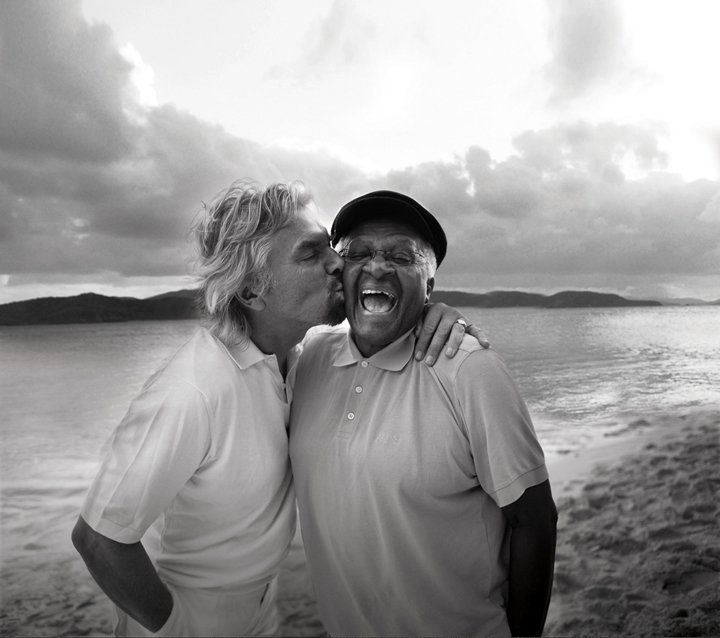
Branson and Archbishop Tutu
If you find yourself experiencing feelings of hatred boiling up, think about how much time you will waste creating more anger. Then think about how you could spend that time differently. I guarantee you’ll feel a little better, and the world will be a little happier. 
I would suggest that everyone reading this ring up someone that they have fallen out with in their lives and invite them out for lunch or dinner. It could be an ex-partner, an old friend turned enemy, or a family member. Remember, there's always two sides to every story and give them the benefit of the doubt.
Branson is missing a point about justice - but his experience makes you think perhaps.


And on Internationl Day of Peace last September, Branson said:
I am joining many others to promote the message that true peace is reached through forgiveness. Forgiving and being forgiven have been recurring themes in my life, and have shaped the person I am today.
The Virgin story could have been very different if I hadn’t chosen to forgive one of my very first business partners, Nik. One day I found a note outlining Nik plans to oust me as Student magazine’s publisher and editor. I felt incredibly betrayed and asked him to leave.
From Student came the idea for Virgin Mail Records. As the operation took off, I could not handle the business’s financials on my own. I called up Nik and offered him a second chance. Forgiving him was one of the best decisions I have ever made. I retained a great friend, became happier at work and in life, and gained the confidence to grow Virgin. Forgiveness brought us both peace and success. We’re still good friends today.
Since those early days, forgiveness has become something of a cultural policy within Virgin. Instead of letting staff go for misbehaving, we have often given them second chances; and as a result have reaped great rewards. It’s amazing how much people lift their game when you put trust and hope in them.
In my opinion, no matter the situation, how badly things have gone wrong, or how much you have been hurt, forgiveness is the best answer. We have been reminded of this time and time again by individuals who make my stories seem trivial. 
I was privileged to recently meet Kim Phuc, who was severely injured as a girl by napalm bombs dropped by US military planes during the Vietnam War. Kim lost family members in the attack, and had to have 17 operations to try to repair the damage it caused. Yet, in 1996, when Kim met the pilot who coordinated the attack, she forgave him. By giving the pilot forgiveness Kim was able to move on with her life and travel the world to promote peace.
17-year-old Malala Yousafzai has become the voice of a generation and an inspiration to all people of all ages, including yours truly. Malala was shot in the head three years ago for speaking out about her right to be educated.
Despite the pain and the trauma she experienced, Malala publically forgave the young solider that shot her. Speaking at the UN she said: “Even if there is a gun in my hand and he stands in front of me, I would not shoot him…. This is what my soul is telling me, be peaceful and love everyone.” Malala’s act of forgiveness freed her to continue to drive her vision of education for all.
And who can overlook Nelson Mandela’s powerful tale of forgiveness. Madiba was jailed for 27 long years of his life. But when he was released he forgave the people who imprisoned him. This forgiveness enabled him to become one the greatest leaders our world has ever seen.
He also brought together The Elders, an extraordinary group working for peace in the world – take a look at what they are doing to forgive for peace too, including Desmond Tutu’s wonderful Forgiveness Challenge.  
Everyone deserves freedom to move forward. Forgiveness is the fastest route to peace. The more inner peace the world’s people have, the more world peace we will all experience.
Love and peace should be our highest aspirations. If you are seeking peace, try to forgive the person who you feel is causing you anguish. And if you feel you’re too proud to forgive, remember these wise words from Gandhi: “The weak can never forgive. Forgiveness is the attribute of the strong.” 
I forgave, and have been forgiven, will you?


Saturday, February 20, 2016

JOINT Enterprise: No voice or justice for victims?

ONE has to seriously question and rigorously examine the apparent change to the legal concept of joint enterprise which was announced this week by senior legal types. They've admitted establishing and applying the Law wrongly for 30 years... three decades. It beggars belief.

Without doubt, the voice of victims, their families and friends has not been heard so far. Observing the media this weekend though, you can see and hear them starting to speak out, having to summon strength and composure to face whatever the Law (supposed to help them) has decided to do to them at the start of 2016.

When most workers get something wrong for a few weeks, they can be fired. Can the legal profession avoid responsibility getting something wrong for 30 years? How can these legal types be held accountable for such a huge mistake? They could help fund anti-violence education across the country, i reckon, for such a disastrous mess up... at the very least, as a start.

Faced with a mistake of such massive magnitude, do we hear profusive apologies to victims' family and friends - and not forgetting the Taxpayer - who have been put through tortuous court proceedings over 30 years? **Tumbleweed** ... no, not a peep.

Which one of these allegedly intelligent (out of touch, mainly old, well-heeled?) legal types will put their hands up and admit they've messed up? **Tumbleweed** ... deafened by the silence.

I was just reading Brooke Kinsella's message on Facebook about the news that could sum up the type of emotional impact bound to be felt by families and friends of the murdered who thought justice had been achieved:
"Am trying not to panic about yesterday's decision - yes it's wrong if a law has been 'used wrongly' for 30 years but it's also wrong that my family and so many more like ours may be right back to square one with nobody even bothering to explain what this means for us and our Justice. And Ben's Justice. My heart goes out to all who are as confused and scared as us right now and hoping we will get the answers we need... "
And Ben Kinsella's father, George, can be heard speaking on the issue here on BBC Radio London's Vanssa Feltz radio show. His interview comes just after 2 hours in (2:05:30).

Other reactions

Campaigner and activist at Advocate for Criminal Justice, Moya Griffiths, lost her son Jourdan in a joint attack. She said: "Could I please ask all those who have received a conviction through Joint Enterprise to contact the MOJ (Ministry of Justice) this afternoon....asking why this ruling, which CANNOT be challenged, has been passed so surreptiously and without any consultation or involvement from Victims families!"

Janet Wilson, mother of one of the teenage boys convicted of murdering Garry Newlove, was reported in the Guardian saying that she hopes the supreme court ruling against the joint enterprise law will bolster the case for her son’s conviction to be thrown out.

Jordan Cunliffe was 15 when he was convicted of the 2007 murder of Newlove, which on Thursday the supreme court ruled had been misinterpreted since 1984.
She said: “You think the person who has done it has been caught and they’re going to be punished and that’s the last of it and you grieve and get on with your life. To have people like me and campaigners popping up all the time; it must be like rubbing salt in the wounds.

“But it was the law that took the wrong turn and the law has put that right now. It’s not our fault. We shouldn’t have to feel guilty but we certainly do feel concerned for the victims because it’s all been unnecessary.”

Stop Press: Please join with me trying to help give young people in London better choices by helping fund education run by The Ben Kinsella Trust - donate to the Three Peaks challenge this summer in Ben's memory (Ben was stabbed to death in 2008). You also have time to take part in the challenge, raise money yourselves, by contacting the trust.